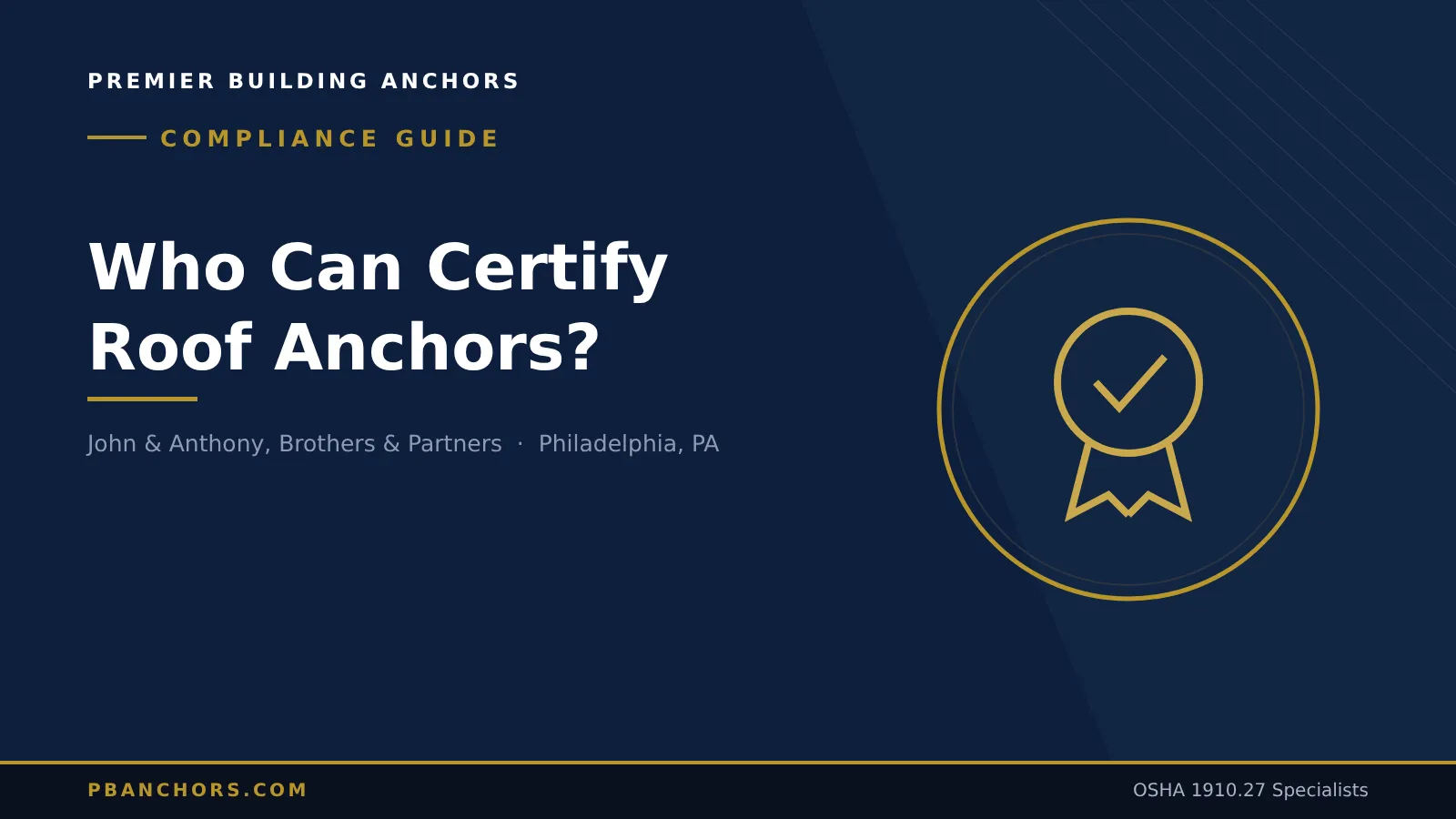
Role confusion stalls projects and quietly creates liability. Here is who can inspect, who can certify, and who should actually sign the paperwork on your rooftop anchors.
If you own or manage a building with rooftop anchors, you have probably heard three different job titles thrown around: competent person, qualified person, and engineer. They get used almost interchangeably by vendors, and that is exactly where the trouble starts. The person who can walk your roof and flag a damaged anchor is not automatically the person who can certify that anchor as safe to use. And the question of who can certify roof anchors is not academic. It decides whether your written assurance holds up when a contractor, an insurer, or an OSHA officer asks to see it.
This confusion costs owners real time. Procurement rejects a bid because the roles were not spelled out. A tenant’s window cleaner will not go up because the paperwork was signed by the wrong person. A recertification gets challenged because a technician did a visual walkthrough and called it a certification. None of that is necessary. Once you understand what each role actually means under OSHA, you can evaluate any vendor in about five minutes.
The person who can spot a bad anchor and the person who can certify a good one are not always the same person. Knowing the difference is your job as the owner, not the vendor’s.
01.
Why the Wrong Signature Is an Owner Liability Problem
Under 29 CFR 1910.27, the building owner, not the contractor, carries the duty to identify rooftop anchorages, have them inspected and certified, and provide written confirmation to any employer before rope descent work begins. That written assurance states that your anchorages have been identified, are capable of supporting at least 5,000 pounds in any direction per attached worker, have been inspected and are in safe condition, and have been certified as needed and at least every 10 years.
Here is the part that matters for roles. A written assurance is only as strong as the competence of the person who inspected and certified the anchors behind it. If that person did not meet OSHA’s standard for the task they performed, your assurance is built on a signature that does not hold weight. In an enforcement review or a lawsuit after a fall, that gap is exactly what gets examined first. You do not want to discover in a deposition that the individual who certified your anchors was qualified to inspect them but not to certify them.
So the roles are not paperwork trivia. They are the foundation of your liability position. Get them right and your documentation defends you. Get them wrong and it exposes you.
02.
The Three Roles, Defined the Way OSHA Defines Them
Two of these terms are defined directly in OSHA’s fall protection standard, 29 CFR 1910.140. The third is a licensing distinction that sits on top of them. Understanding all three in plain language is the whole game.
Competent Person — can identify hazards, can act. OSHA defines a competent person as someone capable of identifying existing and predictable hazards in the work, and who has authorization to take prompt corrective action to eliminate them. Think of this as the spot-the-problem-and-stop-the-work role. A competent person can recognize a corroded baseplate, a loose bolt, or an anchor that looks wrong, and can pull it out of service. But identifying a hazard is a different skill from confirming that an anchor is structurally sound.
Qualified Person — can solve the problem, can certify. OSHA defines a qualified person as someone who, by a recognized degree, certificate, or professional standing, or by extensive knowledge, training, and experience, has successfully demonstrated the ability to solve or resolve problems relating to the subject matter. This is a meaningfully higher bar. A qualified person is the one OSHA points to for annual anchor inspections and for certification. They are not just noticing a problem. They are making the judgment that an anchor can safely carry load.
Licensed Structural Engineer (PE) — can perform structural certification, can design. A professional engineer holds a state license to practice engineering and can be held professionally accountable for structural determinations. Not every qualified person is a licensed engineer, but for the formal 10-year certification and for designing new systems, engineering judgment and a PE stamp are what stand up. The 10-year certification is an engineering conclusion about capacity, not a visual pass or fail. That is why it belongs with an engineer.
03.
Who Can Do What: Inspect, Test, Certify, Design
Here is the practical version, mapped to the actual tasks you will pay for over an anchor system’s life. The pattern is simple once you see it: the bar rises as the consequence of being wrong rises.
| Task | Competent Person | Qualified Person | Licensed Engineer |
|---|---|---|---|
| Spot a damaged anchor and remove it from service | Yes | Yes | Yes |
| Annual qualified-person inspection | No | Yes | Yes |
| Load test an existing anchor and interpret results | No | Yes | Yes |
| Certify anchors and support written assurance | No | Yes | Yes |
| Formal 10-year recertification (structural determination) | No | Case by case | Yes |
| Design a new anchor system or evaluate a modified structure | No | No | Yes |
Two notes on the case-by-case cell. OSHA’s text calls for certification by a qualified person, and a highly experienced qualified person may satisfy that on paper. In practice, a 10-year certification is a structural capacity conclusion, and most owners, insurers, and risk teams expect a licensed engineer’s judgment and stamp behind it. When the stakes are your liability, err toward the engineer.
04.
The Distinction Most Owners Get Wrong
Here is the thing almost nobody spells out for owners: an annual inspection and a certification are not the same event, and they do not require the same depth of analysis. A qualified person performs your annual inspection by reviewing the anchor as it exists today. Certification is a deeper confirmation that the anchorage can still carry the required load, and OSHA requires it at least every 10 years and sooner when conditions change, such as after reroofing or a structural modification.
Where owners get burned is treating a routine walkthrough as if it were a certification. A maintenance tech doing a visual pass is not performing a qualified-person inspection, and a qualified-person inspection is not a 10-year certification. These are three different levels of rigor, and a vendor who blurs them is either untrained or hoping you will not notice. When you understand the ladder, you stop accepting the cheaper, lower-tier service as proof of the higher-tier obligation.
The second surprise: qualified does not automatically mean licensed. OSHA’s qualified person definition can be met through experience, not only through a PE license. That is fine for inspections and testing. It is not the same thing as an engineer’s structural certification. When someone tells you their inspector is qualified, the right follow-up is: qualified to do which task, and who signs the 10-year certification?
05.
How to Evaluate a Vendor’s Competence
You do not need to become a fall protection expert to vet one. You need to ask the right questions and insist the answers come in writing. A credible anchor firm will not flinch at any of these. A vendor that gets vague is telling you something.
- Who specifically will inspect and certify our anchors, by name and role?
- What makes that individual a qualified person under OSHA 1910.140: credentials, or documented knowledge, training, and experience?
- Does a licensed professional engineer sign our 10-year certification, and in which state are they licensed?
- Is the same firm designing, installing, testing, and certifying, or are those split across vendors we have to coordinate?
- What documentation do we receive: anchor identifiers, applied loads, dates, equipment used, results, and a signed certification?
- Does the written assurance you help us produce match the exact language OSHA 1910.27 requires?
- Do you carry professional liability coverage for the certifications you sign?
There is a reason we point owners toward firms where design, installation, testing, and certification live under one roof. When the people certifying your anchors are the same people who install and use them, accountability is not spread across four contractors pointing at each other. At Premier Building Anchors, the engineers who certify are the same team that works on these systems every day through our sister window cleaning operation, which means the judgment behind the signature is grounded in real field conditions, not a checklist.
06.
Common Mistakes
Accepting a walkthrough as a certification
A visual maintenance check is not a qualified-person inspection, and neither one is a 10-year certification. Paying for the lowest tier and filing it as proof of the highest obligation is the most common gap we find.
Assuming qualified means engineer
A qualified person can be qualified through experience. That covers inspection and testing. It does not automatically cover the structural certification, which is where owners expect an engineer’s stamp.
Not asking who signs
Owners often approve a vendor without ever confirming the name and credentials of the person who will actually sign the certification. If it is not in writing, it does not protect you.
Splitting the work without coordination
When one contractor installs, another tests, and a third certifies, gaps open between them. If something fails, each points at the others, and the owner is left holding the liability.
07.
Frequently Asked Questions
Who can certify roof anchors under OSHA?
OSHA 1910.27 requires that rooftop anchorages be inspected and certified by a qualified person, defined in 1910.140 as someone with a recognized degree, certificate, or professional standing, or extensive knowledge, training, and experience in the subject. In practice, the formal 10-year certification is an engineering determination that should be performed and signed by a licensed structural engineer, because it involves structural judgment about capacity, not just a visual review.
What is the difference between a competent person and a qualified person?
A competent person can identify existing and predictable hazards and is authorized to take corrective action. A qualified person clears a higher bar: recognized credentials or extensive knowledge and experience to actually solve the problem. A competent person may be able to spot a damaged anchor. A qualified person is the one who can certify that an anchor is safe to use.
Can the same company that installs my anchors also certify them?
Yes, and often that is the most reliable arrangement, provided the certifying individual meets the qualified person standard and, for 10-year certifications, holds a professional engineering license. What matters is the competence and credentials of the person signing, not that installation and certification are separated. A firm that designs, installs, tests, and certifies with the same qualified staff can be held accountable end to end.
Does an annual inspection count as certification?
No. An annual inspection is a qualified-person review of the anchor’s current condition. Certification is a separate, deeper engineering confirmation that the anchorage can support the required load, and OSHA requires it at least every 10 years and sooner when conditions change. Treating an annual inspection as a substitute for certification is one of the most common compliance gaps building owners have.
What credentials should I ask a roof anchor vendor for?
Ask who specifically will inspect and certify, what makes that person a qualified person under OSHA, whether a licensed professional engineer signs the 10-year certification, what documentation you receive, and whether they carry professional liability coverage. A credible vendor answers all of these without hesitation and puts the answers in writing.
Related guides
- Decision Guide Annual Inspections vs Load Testing
- Compliance Playbook OSHA 1910.27 Compliance Guide for Building Owners
- Documentation Roof Anchor Documentation: What to Have on File
Not sure your current vendor clears the bar?
Premier Building Anchors will review who is inspecting and certifying your rooftop anchors, and tell you straight whether your written assurance holds up. Fast response, 24-hour quoting, licensed engineers on staff.
Request a compliance review · Philadelphia, PA